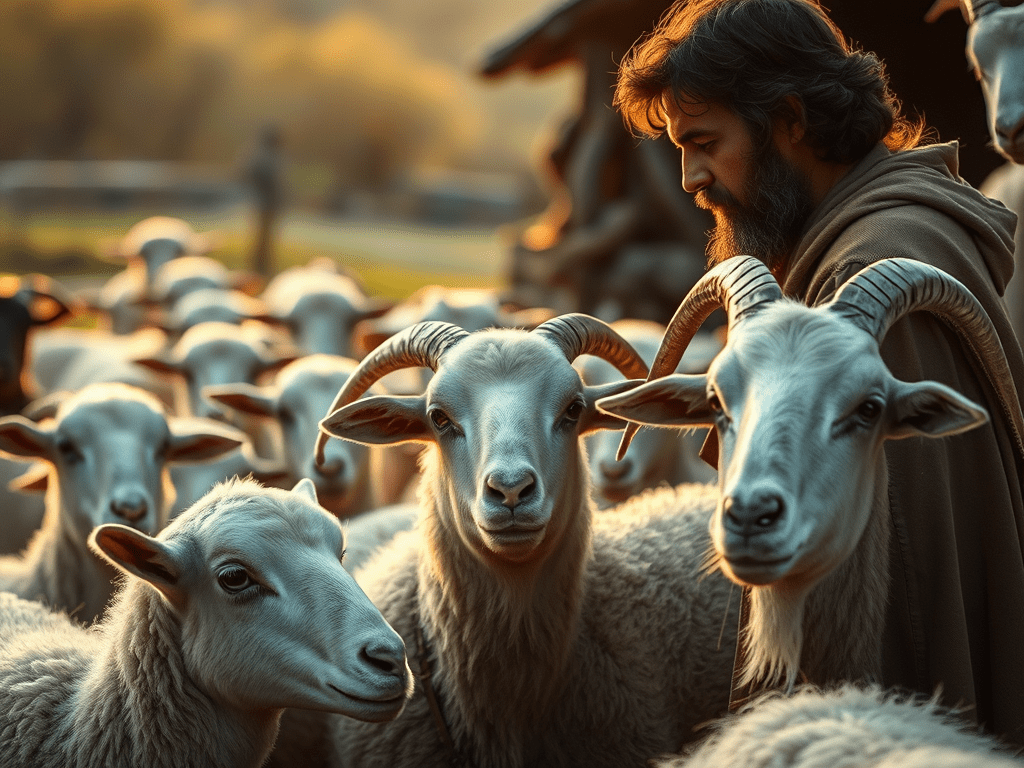
……. and he will separate the people one from another as a shepherd separates the sheep from the goats. He will put the sheep on his right and the goats on his left. – Matthew 25:32 – 33 (NIV)
Our current culture has done an excellent job of elevating “goats” while diminishing “sheep.” As a result, calling someone a “sheep” is often viewed as a harsh insult. The term “sheep” has become synonymous with mindless conformity and thoughtless obedience, implying a lack of critical thinking, individuality, and agency. On the other hand, “goat” has gained popularity as an acronym for “Greatest of All Time.” The term “goat” signifies going against the norm, surpassing one’s peers, and embodying the source of one’s own achievements. Among the popular topics of conversation nowadays, especially in friend groups and on social media, are the numerous ongoing debates about who the “goat” (Greatest of All Time) is in a particular field, from specific genres of music to sports, etc. Being labelled the GOAT signifies being at the absolute pinnacle of success—what more could anyone want? On the surface, this seems like a no-brainer: being a goat is good while being a sheep is bad. However, this notion perpetuates the trope that human beings are infinitely powerful if only we can unlock some hidden potential. This mindset is quite dangerous and reflects an ungodly influence on how many think.
Think of the innate repulsion and outright rejection we often feel towards conformity and obedience. One of my favourite novels, George Orwell’s Animal Farm, depicts sheep as foolish, easily swayed by propaganda, and unable to think for themselves. This portrayal raises concerns about shepherds, who, according to the prevailing narrative, often have their own agendas. Such perceptions contribute to a growing rejection of God and a reluctance to abide by His word. You might be thinking that this is a bit of a stretch, but consider this: the goat symbol has also been adapted into occult and mystical iconography, particularly in the figure of Baphomet, a goat-headed entity commonly associated with esoteric traditions. Biblical scripture illustrates the relationship between God (or Jesus) and His people as God being the good shepherd, while believers are likened to sheep. I don’t think it’s merely coincidental that anti-God symbolism, such as Baphomet, features a goat—an animal that modern culture has elevated above sheep?
The scripture tells us, “Then the King will say to those on his right, ‘Come, you who are blessed by my Father; take your inheritance, the kingdom prepared for you since the creation of the world. For I was hungry and you gave me something to eat, I was thirsty and you gave me something to drink, I was a stranger and you invited me in, I needed clothes and you clothed me, I was sick and you looked after me, I was in prison and you came to visit me.’ ” Matthew 25: 34-36. In this passage, Jesus is depicted as the King who invites the “sheep,” representing righteous believers, to inherit the Kingdom that has been prepared for them since the creation of the world. This inheritance serves as a reward for their lives of compassion and obedience to the will of God.
“The King will reply, ‘Truly I tell you, whatever you did for one of the least of these brothers and sisters of mine, you did for me.’ ” Matthew 25:40 . Here, Jesus explains that serving others, particularly those who are vulnerable or marginalized, is equivalent to serving Him. This highlights the importance that God places on compassionate love, acts of kindness and mercy toward those in need. Based on these passages from Matthew, being a sheep doesn’t seem so bad after all. We are encouraged to live according to the Word of God, and doing so will ultimately set us apart as heirs of the kingdom of God. You may be wondering why being an heir to the kingdom of God matters and why you should care. Inheriting the kingdom of God is a profound gift that grants believers eternal access to God’s presence, where we will experience true joy, peace, and fulfillment beyond anything this world can offer. The kingdom of God embodies perfect harmony and love, free from pain, sin, and sorrow. It is a place where believers can dwell with God, fully embraced by His love.
Now let’s examine what the scriptures say about goats. In Matthew 25:41, it states, “Then he will say to those on His left, ‘Depart from me, you who are cursed, into the eternal fire prepared for the devil and his angels.’” This verse indicates that the “goats” on His left will be banished because they failed to reflect the image of God through love and service to others. It highlights that a life lacking compassion, mercy, and kindness is one that is distant from God. The important takeaway here is not simply about “doing good works” but rather about embodying Christ’s love, which is demonstrated through acts of kindness toward “the least of these.” The phrase “eternal fire” symbolizes separation from God’s presence and illustrates the consequences of rejecting His call to love others.
Now that we understand how God views sheep and goats, being a sheep doesn’t seem so terrible after all, does it? Inheriting an eternity of peace and being in God’s presence definitely sounds much better than being distant from God and facing eternal fire prepared for the devil and his angels. That doesn’t appeal to me at all. In our culture, striving to be “the GOAT” (Greatest of All Time) can seem admirable. However, when we look closer, we see that this path prioritizes self-achievement, independence, and pride—values that contrast with a life surrendered to God’s purpose. The Bible invites us to choose the way of the “sheep,” a path characterized by humility, obedience, and compassion. By embracing this identity, we align with God’s will and find security in His guidance as the Good Shepherd, who leads us to eternal peace.
Ultimately, the true “greatness” we are called to pursue lies not in self-glorification but in reflecting God’s love, serving others, and ultimately inheriting His Kingdom. In a world that celebrates individualism and pride, the call to be a “sheep” reminds us that we are meant to live for something greater than ourselves—a divine relationship that promises joy, fulfillment, and eternal life. While society may exalt the concept of the goat, as believers, let’s strive to embrace the identity of the “sheep,” walking in love and humility under the care of the ultimate Shepherd.





 The Stuttering Believer
Leave a comment